

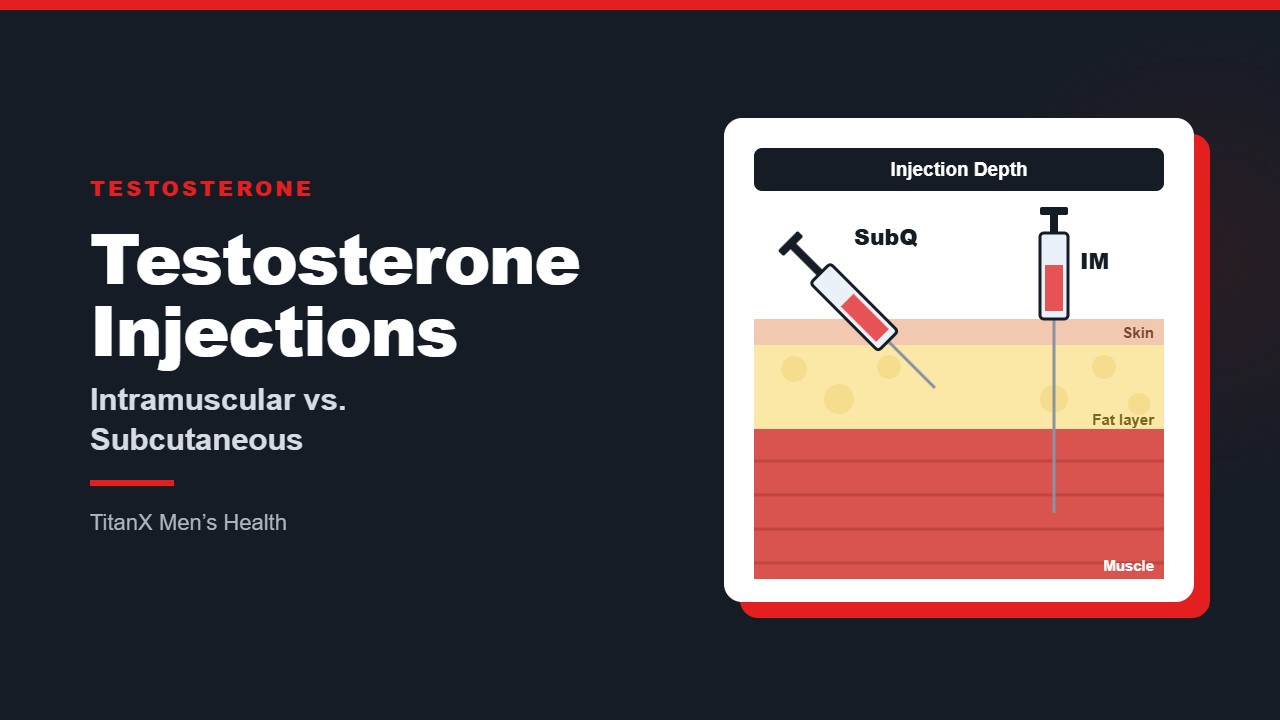
Injections are the most established and most studied way to deliver Testosterone Replacement Therapy (TRT). But not all injections are the same. Testosterone can be injected deep into a muscle (intramuscular, or IM) or into the fat layer just under the skin (subcutaneous, or SubQ). In this article, we’ll explain how each route works, what the research shows about how your levels behave, and how to decide which one fits you.
How Injectable Testosterone Works
Injectable testosterone is attached to a long-acting “ester” and dissolved in oil. Once injected, it forms a small reservoir (a depot) that slowly releases testosterone into your bloodstream over days. The longer-acting injectable forms used for TRT have a half-life of roughly a week.
Injections have real advantages: they are predictable, they have been used for decades, there’s no daily routine to remember, and there is no risk of passing testosterone to your partner or children through skin contact.
Intramuscular (IM) Injections
IM injections are the traditional approach. A longer needle delivers the testosterone into a large muscle, such as the thigh, glute, or shoulder. Muscle has a rich blood supply, so the testosterone is absorbed relatively quickly.
The Peak-and-Trough Pattern
That faster absorption creates a peak. In a classic study of men receiving a larger IM dose every two weeks, testosterone climbed about threefold and peaked 2 to 5 days after the injection, often above the normal range, then drifted back down to baseline by days 13 to 14. Estradiol rose and fell along with it.
Many men on that kind of schedule describe feeling great for a few days, then running out of steam before their next shot. Dividing the same weekly amount into smaller, more frequent injections narrows those swings, which is why most modern protocols use weekly or twice-weekly dosing rather than every two weeks.
Pros and Cons of IM
- Pros: decades of use, predictable absorption, handles larger volumes well.
- Cons: possibly increased discomfort, harder to self-inject in some sites, and higher peaks with less frequent dosing.
Subcutaneous (SubQ) Injections
SubQ injections deliver the same medication into the fat layer just beneath the skin, usually on the belly or thigh, using a short, thin insulin-style needle. Fat tissue absorbs the oil more gradually than muscle, which tends to produce a smoother release.
What the Research Shows
- Similar levels: A 2022 systematic review in the Journal of Clinical Endocrinology & Metabolism found that SubQ doses similar to IM doses produce comparable testosterone levels, with less discomfort. The authors noted that the evidence is still limited and that head-to-head safety studies are still needed.
- Stable between doses: A 2017 study of transgender men on weekly SubQ injections measured testosterone at multiple points across the week and found that levels stayed stable from one injection to the next.
- Strong preference: In another 2017 study of transgender men, 22 patients who switched from IM to SubQ injections all preferred SubQ, and 20 of them described the preference as marked.
- Possibly smaller side-effect swings: A 2022 study of 234 men in The Journal of Urology found similar testosterone levels with weekly IM and weekly SubQ dosing, but the SubQ group had smaller rises in estradiol, hematocrit (red blood cell concentration), and PSA. There are important caveats: the study looked back at existing records, and the two groups used different forms of testosterone and different injection devices.
Pros and Cons of SubQ
- Pros: smaller needle, less pain, easier to self-inject, and steadier levels for many men.
- Cons: some men have difficulty absorbing testosterone from the fat layer, and others develop injection-site reactions such as redness, swelling, or a small lump. These reactions may be related to benzyl alcohol, a preservative found in many injectable testosterone products.
IM vs. SubQ at a Glance
- Where it goes: IM goes into muscle; SubQ goes into the fat layer under the skin.
- Absorption: IM is absorbed faster with a sharper peak; SubQ is absorbed more gradually.
- Average levels: similar when doses are comparable.
- Comfort: IM may cause more discomfort; most men find SubQ easier, though some have absorption issues or injection-site reactions.
- Evidence: IM has decades of data; SubQ evidence is newer but growing and encouraging.
Frequency Matters as Much as Route
Whichever route you use, how often you inject shapes how you feel. Smaller, more frequent doses produce lower peaks and higher troughs than one large dose every couple of weeks. Lower peaks generally mean less of a jump in estradiol and less stimulation of red blood cell production.
Which Route Is Right for You?
Both routes work. The best choice depends on your comfort with needles, your lab trends, how you feel across the week, and your lifestyle. At TitanX, every patient who chooses injections gets hands-on injection training with their Provider, so you’ll leave confident doing it yourself. And if your labs or symptoms suggest a change, switching routes or adjusting your schedule is straightforward.
Final Thoughts
IM and SubQ injections deliver the same medication in different ways. IM injections have the longest track record; SubQ injections are easier for most men and may smooth out the highs and lows. The right answer isn’t the same for everyone, and that’s exactly why your plan should be built around you.
KEY TAKEAWAYS
- IM injections go into muscle; SubQ injections go into the fat layer under the skin.
- Comparable doses produce similar average testosterone levels with either route.
- SubQ injections are less painful for most men and may produce steadier levels.
- More frequent, smaller doses reduce the highs and lows with either route.
- Every TitanX patient on injections gets hands-on training with their Provider.
Keep reading: Testosterone 102 · Concentrated 20% Testosterone Cream
References
- Figueiredo MG, Gagliano-Jucá T, Basaria S. Testosterone therapy with subcutaneous injections: a safe, practical, and reasonable option. J Clin Endocrinol Metab. 2022;107(3):614-626.
- Spratt DI, et al. Subcutaneous injection of testosterone is an effective and preferred alternative to intramuscular injection. J Clin Endocrinol Metab. 2017;102(7):2349-2355.
- McFarland J, et al. Serum testosterone concentrations remain stable between injections in patients receiving subcutaneous testosterone. J Endocr Soc. 2017;1(8):1095-1103.
- Choi EJ, et al. Comparison of outcomes for hypogonadal men treated with intramuscular testosterone cypionate versus subcutaneous testosterone enanthate. J Urol. 2022;207(3):677-683.
- Hormone kinetics after intramuscular testosterone cypionate. Fertil Steril. 1987;47(6):1004-1009.
FIND YOUR RHYTHM
Steady Energy. Every Day of the Week.
Wondering whether injections are right for you? Start with a free, no-pressure Discovery Call with your Provider.
Free · 20 minutes · No commitment