

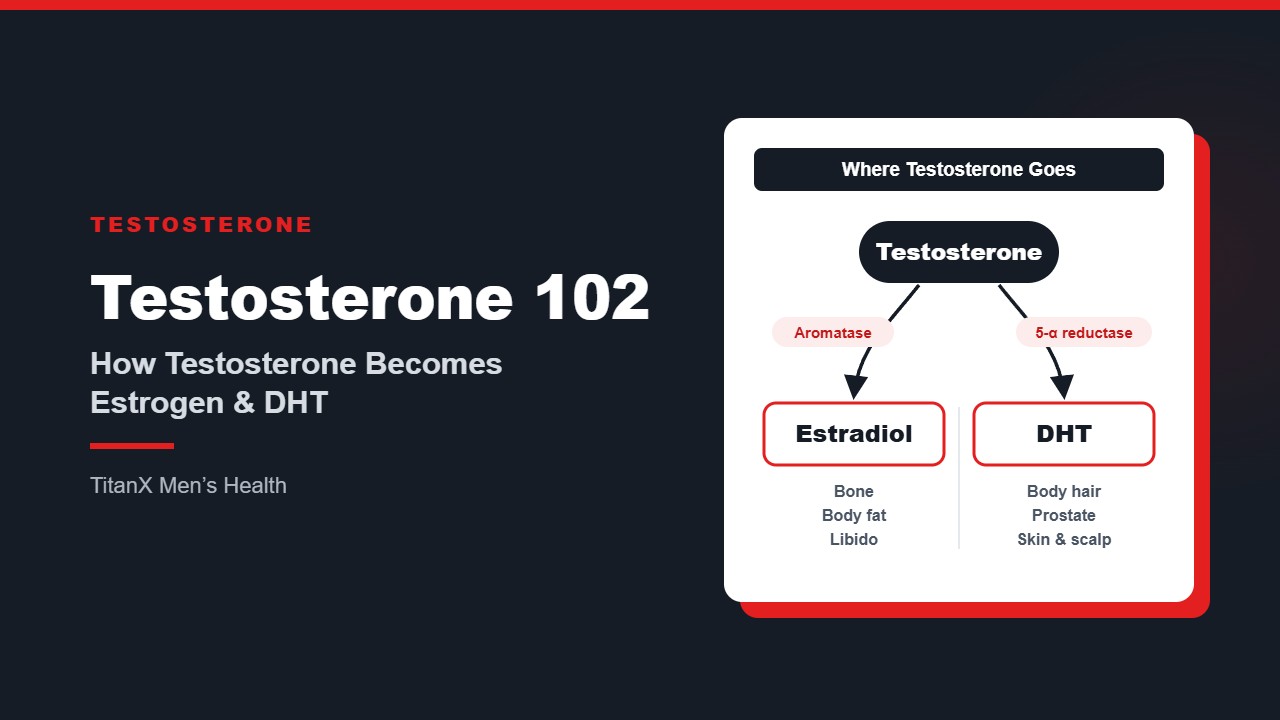
In Testosterone 101, we covered what testosterone is and why it matters for Men’s Health. But testosterone’s story doesn’t end once it’s in your bloodstream. Your body actively converts some of it into two other powerful hormones: estradiol (a form of estrogen) and dihydrotestosterone (DHT). In this article, Testosterone 102, we’ll explain how those conversions work, what each hormone does for men, and why understanding them matters if you’re considering Testosterone Replacement Therapy (TRT).
Testosterone Is a Starting Point, Not a Finish Line
Think of testosterone as a parent hormone. Some of it acts directly on tissues, but some of it is converted by enzymes into other hormones with jobs of their own. Two conversion pathways matter most for men:
- Aromatization: the enzyme aromatase converts testosterone into estradiol.
- 5-alpha reduction: the enzyme 5-alpha reductase converts testosterone into DHT.
Many of the effects people credit to “testosterone” actually come from one of these two hormones. That’s why a good Men’s Health plan looks at the whole picture, not just one number.
Part 1: How Testosterone Becomes Estrogen (Aromatization)
What Is Aromatase?
Aromatase is an enzyme found in many tissues throughout a man’s body, including fat tissue, the brain, bone, liver, muscle, and the testicles. It reshapes the testosterone molecule into estradiol, the most active form of estrogen.
Yes, men need estrogen. In fact, most of a man’s estradiol, more than 80% by some estimates, is made by converting testosterone this way. A man’s estradiol level is only a tiny fraction of his testosterone level, but that small amount does a lot of important work.
What Estrogen Does for Men
One of the most revealing studies on this topic was published in the New England Journal of Medicine in 2013. Researchers temporarily shut down hormone production in 400 healthy men aged 20 to 50, then gave them different doses of testosterone. Half of the men also received a medication that blocked testosterone from converting to estrogen. The results were clear:
- Muscle size and strength depended mainly on testosterone.
- Body fat gain was driven mainly by a lack of estrogen.
- Sex drive and erectile function needed both testosterone and estrogen.
Estrogen also plays a central role in maintaining bone density in men, and it helps regulate the brain’s hormone signals. Too little estrogen is not a good thing for a man.
When Estrogen Runs Too High
Balance is the key. When estradiol runs too high relative to testosterone, men can develop problems such as breast tissue growth (gynecomastia), and some men notice mood changes.
Excess body fat is one of the most common reasons. More fat means more aromatase, which means more testosterone gets converted to estrogen. Estrogen also signals the brain to slow down the hormone (LH) that tells the testicles to make testosterone. Research has shown that higher estradiol levels in men go along with lower testosterone and LH. This helps explain why excess weight and low testosterone so often travel together, and why weight loss can improve both.
What This Means on TRT
When you start TRT, there is more testosterone available to convert, so estradiol usually rises too. That is expected and, in most cases, healthy. How much it rises depends on your dose, your body composition, your genetics, and how your testosterone is delivered. For example, injections that create high peaks can push estradiol up more right after a dose.
Here’s an important point: aggressively blocking estrogen to “chase a number” can backfire. As the research above shows, men with too little estrogen can gain fat and lose libido. Your Provider looks at your symptoms and your lab work together, and usually adjusts the dose, the schedule, or the route before reaching for an estrogen-blocking medication.
Part 2: How Testosterone Becomes DHT (5-Alpha Reduction)
What Is 5-Alpha Reductase?
5-alpha reductase is an enzyme that converts testosterone into dihydrotestosterone, better known as DHT. Only a small share of testosterone, roughly 5%, takes this path, but DHT is the most potent natural androgen your body makes. It attaches to the androgen receptor about twice as tightly as testosterone and lets go about five times more slowly. In laboratory testing, DHT is anywhere from 2.5 to 10 times more potent than testosterone. Unlike testosterone, DHT cannot be converted into estrogen.
There are two main types of this enzyme:
- Type 1: found mostly in the skin, oil glands, and liver.
- Type 2: found mostly in the prostate, genital tissue, and hair follicles.
Because the enzyme works inside these tissues, DHT acts mostly where it’s made. Levels of DHT in the blood are only about a tenth of testosterone levels, but inside the prostate, DHT levels are several times higher than testosterone.
What DHT Does for Men
DHT is essential for normal male development. Boys born with a rare genetic deficiency of the type 2 enzyme are born with genitals that look female and then masculinize at puberty. In adult men, DHT is a major driver of:
- Beard and body hair growth
- Prostate growth, including the gradual enlargement many men experience with age
- Oil (sebum) production in the skin, which can contribute to acne
- Male pattern hair loss in men who are genetically prone to it
DHT, Hair Loss, and TRT
Male pattern hair loss runs in families. In men who carry those genes, hair follicles on the top of the scalp are sensitive to DHT and gradually shrink over time. Raising testosterone can also raise DHT, so if baldness runs in your family, TRT may speed up a process that was already underway. If that’s a concern for you, bring it up with your Provider. Medical hair preservation treatment can help protect the hair you have.
How testosterone is delivered also matters. Skin is rich in 5-alpha reductase, so testosterone that is absorbed through the skin tends to raise DHT more than injections do. A comprehensive review in Endocrine Reviews concluded that the modest DHT increases seen with TRT are unlikely to be a cause for clinical concern, but it is one more reason the route of delivery should be matched to the man.
TRY IT YOURSELF
Have your lab results? Estimate your free testosterone with the Free Testosterone Calculator, or switch between ng/dL and nmol/L with the Testosterone Unit Converter. Browse all of our free Men’s Health calculators.
Why This Matters for Your Treatment
Two men with the same testosterone level can feel completely different, partly because of how their bodies convert testosterone into estradiol and DHT. That’s why TitanX takes a personalized approach:
- We look beyond a single number. Symptoms, body composition, and lab trends all matter.
- We match the route to the man. Injections and topical testosterone handle these conversions differently.
- We treat the whole person. Weight loss, sleep, and exercise can shift your hormone balance as much as medication can.
Final Thoughts
Testosterone doesn’t work alone. Through aromatization, it becomes estradiol, which protects your bones, controls body fat, and supports your sex drive. Through 5-alpha reduction, it becomes DHT, which drives male development, body hair, prostate growth, and, for some men, hair loss. Keeping these hormones in balance, rather than pushing any one of them as high or as low as possible, is the foundation of safe and effective TRT.
KEY TAKEAWAYS
- Testosterone is converted into estradiol (by aromatase) and DHT (by 5-alpha reductase).
- Men need estrogen: it supports bone, body composition, and sexual function.
- Excess body fat increases estrogen conversion and can lower testosterone.
- DHT is the most potent natural androgen and drives body hair, prostate growth, and hair loss in men prone to it.
- The goal on TRT is balance, not blocking hormones to hit a number.
Keep reading: Testosterone 101 · Testosterone Injections: Intramuscular vs. Subcutaneous · Concentrated 20% Testosterone Cream
References
- Finkelstein JS, et al. Gonadal steroids and body composition, strength, and sexual function in men. N Engl J Med. 2013;369(11):1011-1022.
- Raven G, et al. In men, peripheral estradiol levels directly reflect the action of estrogens at the hypothalamo-pituitary level to inhibit gonadotropin secretion. J Clin Endocrinol Metab. 2006;91(9):3324-3328.
- de Ronde W, de Jong FH. Aromatase inhibitors in men: effects and therapeutic options. Reprod Biol Endocrinol. 2011;9:93.
- Grino PB, Griffin JE, Wilson JD. Testosterone at high concentrations interacts with the human androgen receptor similarly to dihydrotestosterone. Endocrinology. 1990;126(2):1165-1172.
- Thigpen AE, et al. Tissue distribution and ontogeny of steroid 5α-reductase isozyme expression. J Clin Invest. 1993;92(2):903-910.
- Swerdloff RS, et al. Dihydrotestosterone: biochemistry, physiology, and clinical implications of elevated blood levels. Endocr Rev. 2017;38(3):220-254.
BALANCE, NOT GUESSWORK
Stronger. Sharper. Confident.
Curious how your hormones are really working together? Your first step is a free, no-pressure Discovery Call with your Provider.
Free · 20 minutes · No commitment